Investigating the Effects of Eco-Friendly Service Options on Rebound Behavior in Ride-Hailing (Conditionally Accepted)
Abstract
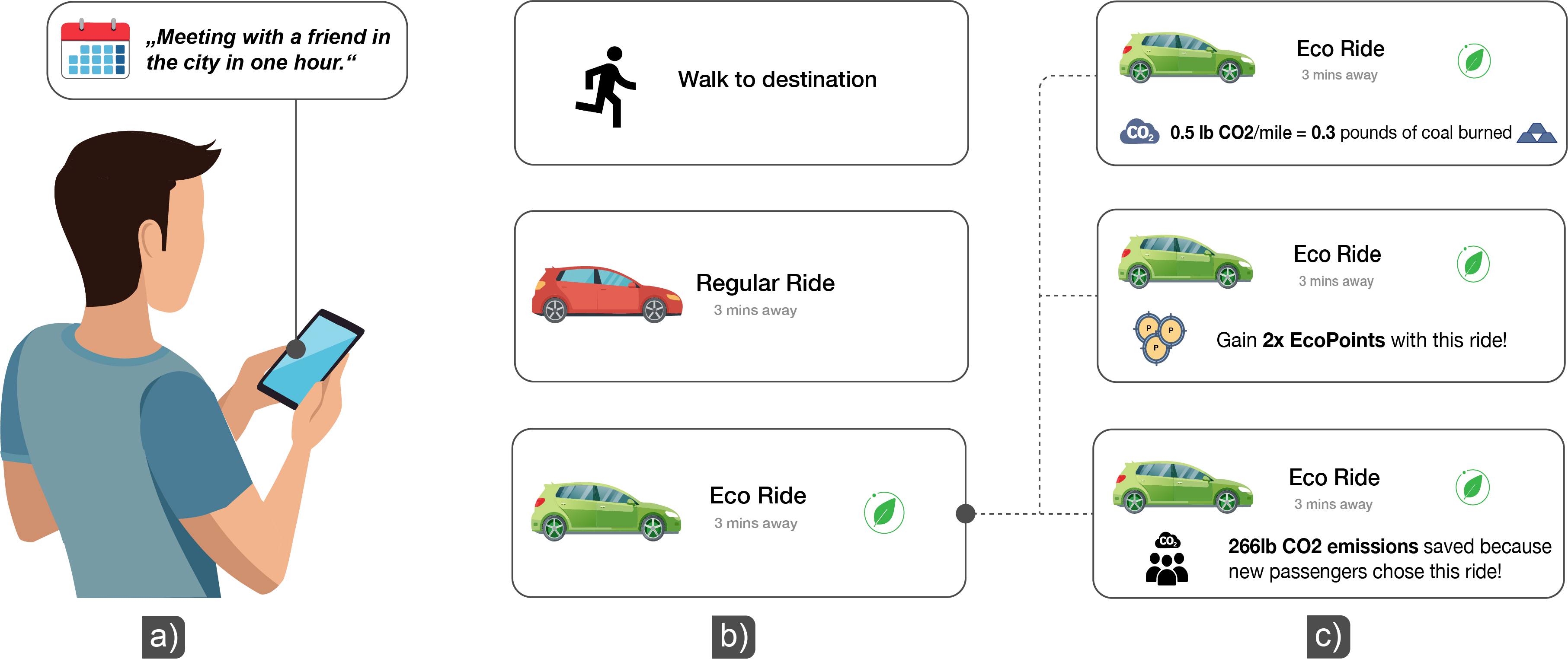
Eco-friendly service options (EFSOs) aim to reduce personal carbon emissions, yet their eco-friendly framing may permit increased consumption, weakening their intended impact. Rebound effects of this kind remain underexamined in HCI, including how common eco-feedback approaches shape them. We conducted an online within-subjects experiment (N=75) in a ride-hailing context. Participants completed 10 trials for five conditions (No EFSO, EFSO - Minimal, EFSO - CO2 Equivalency, EFSO - Gamified, EFSO - Social), yielding 50 choices between walking and ride-hailing for trips ranging from 0.5 mi–2.0 mi (≈0.80 km-3.22 km). We measured how these EFSO variants affected ride-hailing uptake relative to a No EFSO baseline. EFSOs lacking explicit eco-feedback metrics increased ride-hailing uptake, and qualitative responses indicate that EFSOs can make convenience-driven choices more permissible. We conclude with implications for designing EFSOs that begin to take rebound effects into account.